
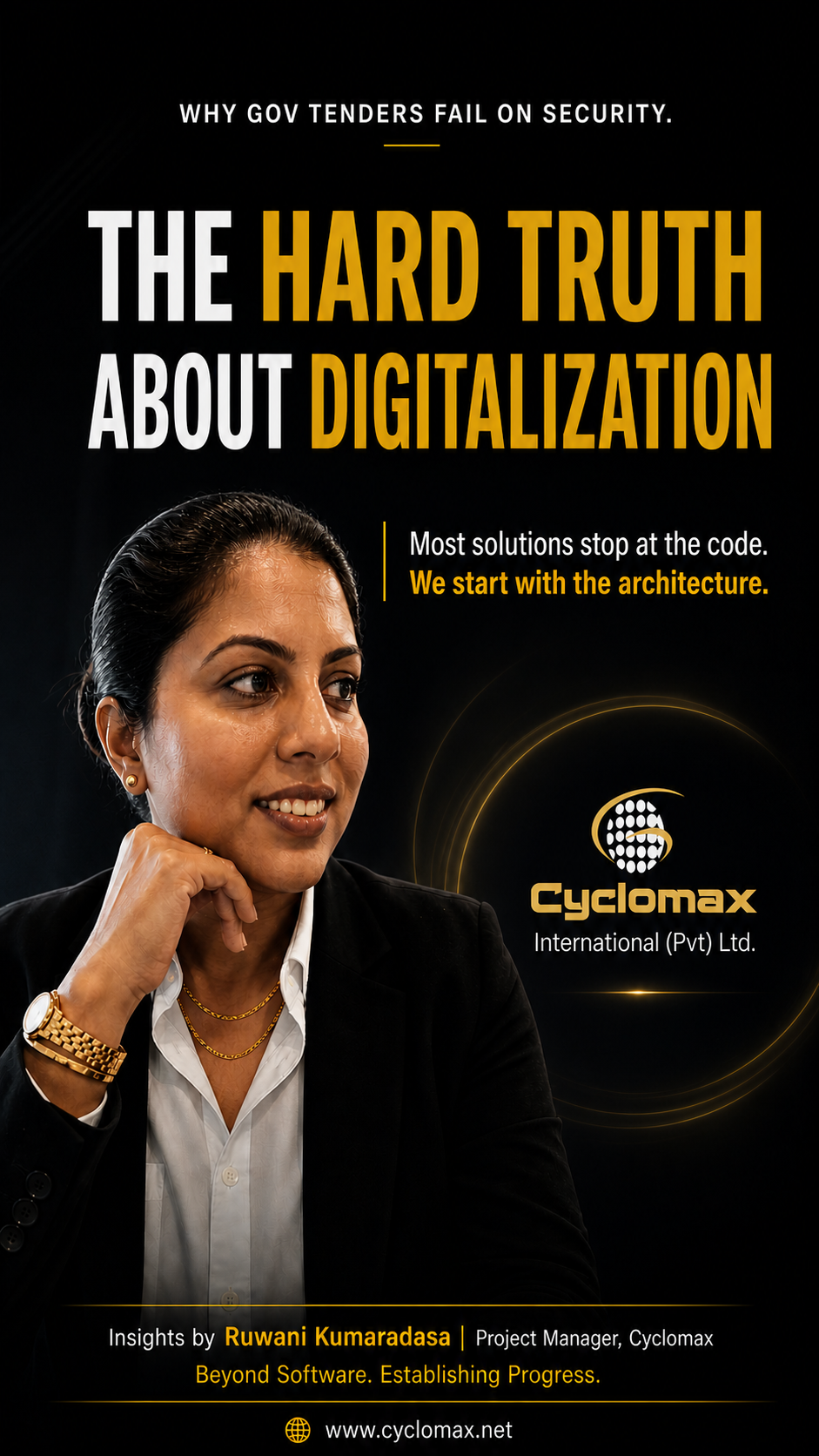
By Ruwani Kumaradasa | Project Manager, Cyclomax International
In the world of government digitalization, there is a dangerous trap that many fall into: the “Low-Bidder Trap.”
As a Project Manager at Cyclomax, I see this often. A government body issues a Terms of Reference (TOR) for a new digitalization effort. While most government bodies have dedicated IT departments, the reality of public sector salary scales makes it incredibly difficult to attract and retain highly specialized IT professionals. As a result, these TORs are frequently drafted by dedicated civil servants who are managing massive responsibilities with limited resources, but who may not have deep expertise in modern infrastructure or changing national protocols. They ask for solutions, but they might miss the “invisible” foundations—the server architecture, the compliance frameworks, and the long-term maintenance costs that keep a nation’s data safe.
At Cyclomax, we’ve decided to lead with a different philosophy. We don’t just “tick boxes” to win tenders. We advocate for the infrastructure that actually works.
1. Beyond the Software: Infrastructure is the Backbone
A solution is only as strong as the ground it stands on. When we discuss “Big Data” in a government context, we are talking about more than just storage. We are talking about redundancy and scalability.
Server Architecture: We design for high availability, ensuring that critical services—whether for utility boards or industrial sectors—never go down.
Data Centers: We advise on tier-level standards to ensure physical and environmental security for data.
Cybersecurity Implementation: In an era where vulnerabilities are a daily headline, we don’t treat security as an “add-on.” It is built into the core architecture from day one.
2. The Danger of the "From-Scratch" Trap
Keeping up with the latest national data policies, approved digital signature methods, and compliance frameworks is a full-time job. Because the officers drafting the TORs may not be fully updated on these new government policies, there is a tendency to request completely independent, isolated systems built from scratch.
This is a massive risk. Building an independent system without aligning to relevant national frameworks means there are no standardized protocols. Worse, it creates unmaintainable silos. We ensure our solutions integrate with approved national methods so they can be securely maintained for years to come.
3. The Illusion of the "One-Time Cost" (Planning for AMC)
Another critical gap we see in government tenders is the lack of foresight regarding Annual Maintenance Contracts (AMC) and ongoing support costs. Often, a TOR will focus entirely on the initial development budget. But a national-scale digital system is a living entity. It requires continuous security patches, infrastructure scaling, and operational support.
When government bodies fail to account for the true cost of after-care, the system is doomed to become obsolete or vulnerable within a year. As part of our consultancy, we help agencies forecast these long-term operational costs, structuring proper Service Level Agreements (SLAs) and AMCs before the project even begins.
4. The Expert’s Responsibility: Educating the Stakeholder
Because tenders are frequently “under-specced” regarding infrastructure, policy, and maintenance, low-budget bidders often quote only for the software code.
Our approach is different. We act as consultants. We sit with the policy-makers and IT officers to explain why an infrastructure upgrade or a proper AMC is necessary. Sometimes, this means negotiating for a more robust budget or changing internal procedures to meet global security standards. We aren’t just winning a bid; we are protecting a government asset.
5. Managing the "Psychological Pivot"
High-end architecture is useless if the people don’t use it. We focus on Psychological Enhancement—the process of helping non-digital workers understand the “why” behind the security and the data entry. When a worker understands that a digital signature isn’t just a technical hurdle, but a protection for their own work, the system succeeds.
6. Establishing a Legacy, Not Just a Login
Digitalization is a massive architectural undertaking. It requires manipulating big data, adhering to national policies, forecasting long-term costs, and upskilling everyone from the treasury to the data entry clerk.
By the time a Cyclomax project is “up and running well,” we haven’t just delivered a software package. We have established a secure, standard-compliant, and high-performing digital ecosystem that is built to last.
Contact Cyclomax International:
Phone: +94 37 2234754
Email: info@cyclomax.net
Website: www.cyclomax.net


